

How To Clean Switches On Pinball Machine
How to adjust switches on a pinball machine and make the game play more active
Adjusting switches is an important task to do. It tin can make a pinball machine play better and more fun. Badly adjusted switches may cause all kinds of issues on a pinball motorcar (worst case scenario: coils that burn down), or can brand the game no fun to play. It's not hard to do, however you need to know how it's washed. Explaining it in words is not easy, so I promise the pictures hither help so you larn it.
Near of the switches used in a pinball car are leaf switches. These are 2 (sometimes more) metal plates that have contact points on them. At their base they're stuck together by screws and some kind of isolator between them.
Tools to adjust a leaf switch
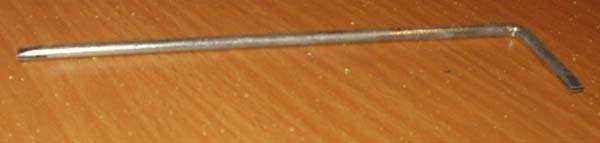
Normally a 'switch aligning tool' is all you demand. You tin purchase this from most pinball parts dealers. Information technology's just a metallic bar, commonly bend in an 50-shape so yous take a brusk and long leg, for difficult to achieve switches. At the ends there'south a slit in it so you can slide it over the metal blade of a switch and bend this. And then to 'adjust switches' ways you lot bend the blades of the switch so the distance between the contact points becomes larger or smaller.
Always be conscientious when you curve switches. The blades can break if you bend them too sharp. Try to adjust a blade switch at the bottom of the stack (about the part where the blades are held together with screws) and not at the finish.
As a blade switch consists of two blades, y'all take to know which one to adjust. The upper blade (usually the longest one) is the blade which moves when the switch is pushed in. Ordinarily y'all do not adjust this. Only if yous desire to adapt the pressure needed to make contact, yous tin conform this bract. The sensitivity of a blade switch is adjusted past changing the position of the shorter, stationary blade. By making the distance between the two blades smaller the switch becomes more than sensitive, set them further apart and the switch becomes more insensitive.
First job when adjusting switches is to clean them. Make clean the contact points of blade switches. Push them gently together and pull a business card or similar type of thick paper through them. That'due south all you lot need to practice to make clean about types of blade switches. Only on some very specific types of high-voltage switches (usually cease-of-stroke switches on older games) you need a file. Using a file on low-ability switches volition destroy them ! Also do non use any kind of chemical cleaner as they tin go out a residu backside.
Most switches y'all want to set very sensitive, simply not besides sensitive. A sensitive switch will make the game more than lively (kickers, slingshots and bumpers volition react better) and brand the thespian enjoy the game more. It'south very frustrating for a player to have a switch on a game which only registers when information technology'southward i.e. shot very hard or at a certain angle.
A switch which is fix too sensitive will effect in phantom closures. A slingshot may trigger itself over and over, or one pop bumper may trigger the i next to information technology too. You don't desire this to happen. One test for this is to hit on the playfield with your fist, the vibration this makes may not trigger whatsoever switch !
There are 2 types of bract switches: usually open and usually closed.
Commonly open up switches are equally their proper name says, open up in normal condition. Only if they are activated by a pinball the blades will shut and brand contact.
Normally closed switches are the opposite: they're closed all the time unless the pinball opens the blades.
About switches on a playfield are commonly open. But you take to know what type you're dealing with before you tin can adjust information technology.
Electronic pinball machines have switch tests. If yous go into this mode and close a switch, the car will say which switch it is. That way you can check a switch works well and the correct 1 gets detected (you have to look upward the switch number in the manual). Sometimes the self-tests will say a certain switch needs adjustment. This happens when a switch has non been triggered in the last xxx games (or around that number). This does non always hateful the switch needs adjusting, maybe it's in a position on the playfield where information technology was not striking by a ball. But go into the switch examination and examination if the switch registers.
Blade switches are cocky-cleaning. To exist perfectly ready upward, blade switches should be adjusted that style that they clean themselves. They exercise this past moving over each other in a wiping motion. Yous do non want the contactpoints to touch each other perfect and stay in that position when the switch is pushed in further ! One blade should motility a bit over the other, and thus wiping the others contactpoint clean.
Pop bumper switches
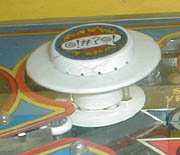
So how do pop bumpers piece of work ?
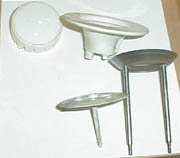
A bumper consists of parts above the playfield and under the playfield. The most important parts above the playfield are the bumper skirt (the flat plastic which is just above the playfield) and the bumper ring (the metal ring).
When a ball rolls towards a bumper, information technology will first touch the bumper brim. As yous can see in the picture of the parts, this flat plastic has a long pivot in the middle which sticks through the playfield. Underneath the playfield this ends in a kind of plastic spoon, to which a switch is fastened. The pinball makes the skirt move, the long pin on the skirt moves the spoon part which closes the switch. At present the pinball motorcar knows the bumper has been hit, and this volition trigger the ringlet which pulls the metal band down and thus kicks the pinball away.
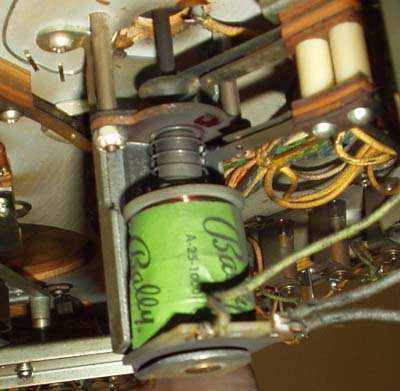
The goal is to conform the switch on this spoon equally sensitive as possible. But every bit bumpers brand a lot of vibration when the metal band kicks down, it may not be gear up too sensitive because and so vibration from i bumper may trigger some other one to fire.
In the picture yous see 2 switches at this bumper. Not all types of games have this, more than modern games only have one blade switch. Only the height ane is of import, this will trigger the coil to fire and its adjustment sets how sensitive the popbumper is. The lesser switch is only there to keep the score, information technology gets activated when the metallic ring is pulled down.
So bend the upper switch and so that it'southward almost closed, affect gently the bumper skirt and encounter if this makes the switch close. And so play a game and check that the switches are not set too sensitive and bumpers burn down when the pinball does not hit them. If they are too sensitive and then you have to adjust the switches again and then the gap betwixt the blades is a little bit bigger. It may be necessary to use a pocket-sized mirror and so you lot can encounter the gap between the blades.
While you are adjusting switches, as well cheque the residual of the pop bumper assembly. Make certain the bakelite and metal plate are not broken and the bumper ring is held tight with ii screws.
Slingshot switches
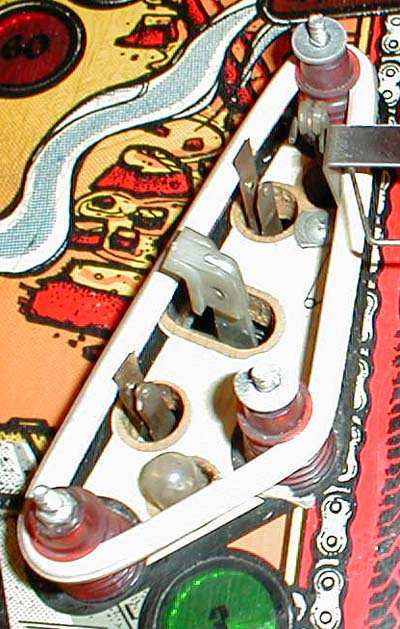
Slingshot switches (or other types of kickers) work like to popular bumpers. In a higher place the playfield are ii switches, which simply impact a safe ring. A pinball rolls into the rubber ring, this bends dorsum and closes ane of the switches. This in plough activates the ringlet and the kicker arm kicks confronting the rubber band and the pinball away.
Both foliage switches are connected to each other, the cpu sees them as but one switch. Continue this in mind when troubleshooting the switch matrix, as non-working slingshots tin be because the wiring between the two switches has a fault.
At first sight, the top switch in the picture is open too far. The bottom ane looks better regarding distance between the blades. But this still has to be tested.
With the new rubber ring on, the front blade of the switch should touch the rubber band, and the bract in the back should be close to it, but non making contact. Try to bend switches from below the playfield and not only the top part which sticks in a higher place the playfield.
Slingshot switches also have to be tested for their sensitivity. When the slingshot has fired, its rubber ring will bounciness back in position and vibrate a bit. If the slingshot switches are set besides sensitive, this vibration may cause them to become off over again, resulting in a slingshot which triggers itself over and over. It's a fine line between a switch which is sensitive plenty and likewise sensitive.. Yous take to experiment a bit. You want to adjust them correct on the edge. A pinball which rolls down against the safety band should get kicked away, although this depends also on the hardness of the condom ring.
Proceed in mind that rubber rings tin can differ in size (thickness). And so if switches were already adjusted and you put a new rubber ring on this assembly, you lot may have to cheque its adjustment again.
When I had finished shopping my Whitewater, none of the slingshots worked. Even in the switch matrix they did not register when I pushed against the condom. The switch matrix too did not report them as bad or airtight. So I was already thinking that some wires were broken of I had a switch matrix problem. But when I pulled the rubber ring, suddenly the slingshot fired. On closer inspection I learned that the new rubber rings I put on were much thicker than the old ones. Therefor all slingshots switches were permanently closed, and because they were already when I switched the game on, the cpu marked them as 'bad' and did not report them as closed in the switch test. I merely adjusted all switches to be 'normally open' and they worked fine.
End-of-stroke switches
To sympathise the importance of cease-of-stroke switches (EOS) you have to understand how flippers work. On nearly every blazon of pinball machine, a flipper coil is different from a regular coil. It's 2 windings in ane bundle, one powerful one which uses high voltage, and a less powerful ane which uses lower voltage. You lot demand the high power winding to move the flipper bat up, and kick a pinball away. Simply if keep the flipper bat in the up-position (i.e. to trap a pinball) this can overheat and damage the flipper coil. So therefor at that place'due south a low voltage winding too. One time the flipper bat is in the up-position the coil switches to this lower 'hold' voltage, so information technology tin can stay in that position for minutes without damaging the coil. Therefor the EOS-switch is needed, to know when the flipper is in the up-position and to make/intermission the ability/concord excursion.
EOS switches also be as normally open and normally closed types. WPC games utilise normally open switches, older games normally take normally airtight circuits. The example here is with a normally open type of game. If you have a normally closed one so inverse the logic (when the one type closes, the other should open and vice versa).
A misadjusted EOS-switch tin can influence a lot how flippers experience. If it gets activated likewise soon, the coil is non able to piece of work on total ability for long enough. Flippers experience weak, balls are non flipped away very powerful and far away targets or steep ramps are maybe impossible to shoot.
If the EOS-switch is not activated at all, the scroll will work all the time on high power. It will overheat and loose power, and in the end get physically damaged.
Note that on WPC fliptronic games the switch to hold power is not washed by the eos-switch itself but through microprocessors. When the flipper is activated, the game over to concord-voltage after a few micro-seconds. Then even if EOS-switches don't close at all yous can non damage the coil. However this will all the same influence gameplay. EOS-switches also brand sure that a flipper in the up-position will not drop down when i.e. a pinball falls in it.
If you have a flipper bat in the upward-position with a ball trapped on it and another ball comes downward from the playfield and hits the flipper bat difficult, the hold power is not strong plenty to continue the bat in the up-position. Information technology volition autumn down. This volition shut the eos-switch and the gyre will switch dorsum to full power and enhance. If the eos-switch does not close once more (or as well late), the flipper bat will fall down and you might loose the pinball.

This image shows a flipper mechanism on a WPC game (usually open) in rest. The flipper is downwardly, the roll is non activated, and the eos-switch (left of the bluish gyre) is open up.
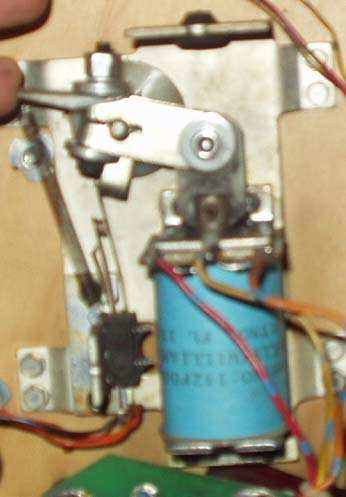
This picture shows the situation in the upward-position. The roll is activated and the metal plunger is pulled in. This makes the crank rotate and the metal arm on it closes the eos-switch.
You want to adjust the eos-switch so it only closes when the flipper is (almost) in the complete up-position. Not before, and certainly not half-way.
Simply on games which are played continuously for hours and however become problems with overheating coils you may desire to adjust the eos-switch so it closes a bit sooner. I'd say and then between 3/4 and the full end of the length the flipper moves up, as information technology'll then be a bit less long on high-voltage.
The superlative part often breaks off from eos-switches, and the arm of the crack can stick backside information technology. The event is that the flipper bat does not ever render back to the lower position when the ringlet isn't activated anymore. You then have to install new eos-switches which are long plenty. So especially take when adjusting the eos-switches that you don't pause the ends.
Rollover switches

Rollovers exist is several types, flat plastic ones similar in the picture, or star-shaped plastics. They are a very simple design: a plastic part sticks through the playfield and has a pin in the middle. This pin sticks through the playfield and rests onto a bract switch. In normal position the upper blade of the switch keeps this light plastic role up above the playfield. The weight of a pinball rolling over the target makes the blade go down and brand contact.
So you if yous accommodate the top blade of the switch, on almost types yous tin adjust how high the plastic sticks above the playfield, or how much pressure is needed by a pinball to lower it. Usually you practice not take to suit this, unless someone messed with it.
More important is the position of the lower blade (and thus the distance between the contact points of the switch) as it defines how sensitive the switch is. Once more, you want to make this switch sensitive without introducing false hits. Usually the plastic the switch should shut when the plastic is halfway pushed in.
Microswitches
Microswitches are totally different from bract switches. They just look like a little box with a small nipple extending from it and a metal wire on them (the 'actuator arm'). When the metallic wire gets pushed downward, the nipple goes into the pocket-size box and yous hear a distinct clicking audio.
Adjustment here is washed by angle the metallic arm. Normally it sticks through the playfield. If it does not stick upwardly high enough, a pinball can coil over information technology without activating the microswitch. If it sticks upward besides high, it tin can cause a ball trap, a slowly rolling pinball gets stuck behind it. So you lot have to exam for both situations and accommodate. Also go on in mind that in some positions (similar loops on the playfield) the pinball tin can roll in both directions over the metal arm, because the way information technology's bent sometimes works fine in one direction but still causes a brawl trap when a pinball goes in the other direction.
Commonly there are ii positions where the metal arm can plug onto the microswitch body. Sometimes information technology's necessary to switch the position and then the arm has a higher angle.
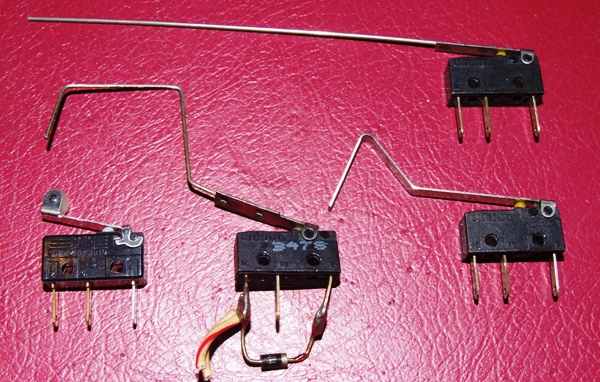
The flick shows different types of microswitches. The actuator is the but deviation between them, the switch role itself is the same. All different types accept different part numbers. And then if you want to replace a bad microswitch only can not guild information technology somewhere, merely take another microswitch and switch the metal actuator. Or you can purchase merely a generic switch (top of picture) on which you tin can bend the arm in whatever shape you want.
WPC95 games are known to employ inexpensive microswitches which frequently become bad. So if you take a WPC95 with microswitches which sometimes register and sometimes not, (or even register fine in the switch matrix test just not during gameplay), and then save yourself a lot of frustration, don't endeavour to arrange them but just replace with a new microswitch.
Opto switches
Opto switches are a special type of switch. They don't have any moving parts. It's an optic (infrared) beam that is cleaved by a passing pinball. They consist of ii parts, an emittor (which is an infra-red led) and a receiver (a led that is sensitive for infrared calorie-free).
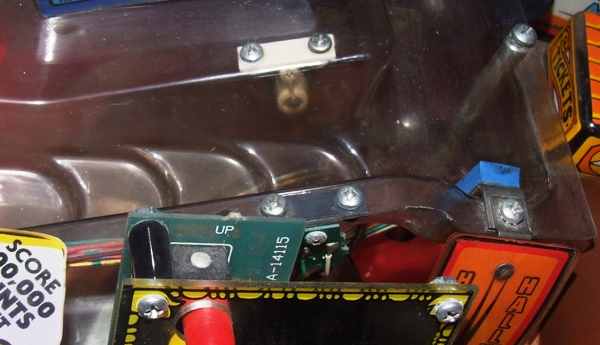
Opto switch on a Funhouse ramp.
Optos are often used at the entrance or on plastic ramps. Both parts are mounted on reverse sides. A pinball that passes breaks the axle. This is detected and communicated to the cpu.
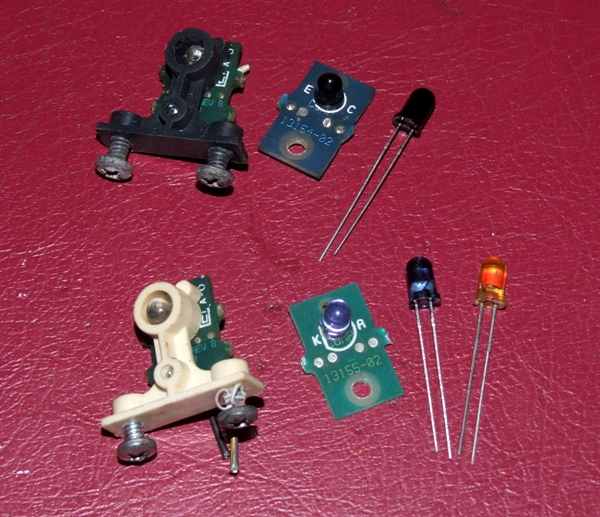
Unlike types of optos.
Receiver is at the top: dark green pcb, with dark colored example. Emitter at the bottom: light light-green pcb, white colored instance. From left to right - consummate assembly, pcb and the private led itself.
When y'all have problems with optos - first outset by cleaning them. Often they're just dirty, or the ramp they smoothen through (like in the picture to a higher place on Funhouse) is too muddy.
Y'all cannot see the infrared beam by your own lights, but a digital camera tin can. To exam if the IR-emitter works, just take a digital photographic camera (a meaty photographic camera or the one in your cellphone volition practise) and await into the opto. You should encounter the led alight, as if it was a regular led. Of both components the IR-emitter led more often than not breaks downwardly.
Testing the IR-receiver is done unlike. Go into the switch matrix test, and cake the axle from the IR-emitter. The switch should annals in the exam. As information technology's sensitive to IR lite, you can utilize a regular flashlight to shine into it and information technology should also register. Note this does not work with flashlights that have leds - only with an incandescant bulb. You can also measure the receiver with a multimeter. Measure DC volts betwixt ground and the grey wire on the pcb. You should measure 12vdc. Shine a flashlight into the receiver led and the voltage volition drib and become close to 0 volts.
When you lot led (emitter or receiver) is bad, you have to replace information technology. Buy a new one (consummate pcb) or but desolder and supervene upon the led itself.
Retrieve - Kathode = short leg, marked with K (or E) board, commonly the flattened side of the led.
The leds need to be sensitive for 880nM wavelength.
Notation your optos all require 12 volts to piece of work. When all of them requite an error, either doubtable the opto lath under the playfield. This opto lath is pretty simple, and contains some resistors and LM339 ics.
Besides inspect the powerboard in the backbox for the presence of 12v: on WPC: LED ane, testpoint iii, bridge rectifier BR1 and fuse F115. On WPC95: LED100, TP100, fuses F101 and F106.
Eddy switches
Eddy switches were designed by Williams and are just used on a few of their contempo pinball machines. They exist in two types. The oldest ones tin be manually adjusted (as used on Road Testify, Theatre of Magic and Scared Stiff), while the modern version are 'auto-adjusting' (used in Cirqus Voltaire and Monster Bash), you lot cannot accommodate them yourself.
The consist of 2 parts, a sensor pcb which detects the ball, and a driver board. On this commuter board there's a led which lights when the pinball is detected by the sensor, and a potentiometer with which you can adjust the sensitivity.
Hold a pinball over the sensor. Turn the potmeter clockwise until the led lights. You desire to set the switch as sensitive as possible, and so plough only until the led lights. Vibrations tin can sometimes alter the aligning. If this is a problem and y'all frequently demand to adjust information technology again, and so you lot have two options. Y'all tin turn the potmeter a bit more clockwise, so you lot take a larger margin, just this will likewise make it less sensitive. You can also use a drop of nailpolish or superglue to go along the potmeter in position.
Eddy sensors frequently have issues with bad connectors. And so if information technology'south set up correctly simply doesn't register in the switch matrix test, or the led doesn't light at all, then cheque the connectors on the boards. If you cannot solder or employ a multimeter then let someone practise this for you.
Magnetic Reed switches
Simply similar Eddy switches, reed switches (MRS) work with magnetism. They notice a pinball that rolls over them. The switch itself looks like a long black plastic box.

There is nothing you tin adjust with this type of switch. They either piece of work or they're broken. They besides plug in directly in the switch matrix, they do non need a diode or extra commuter pcb.
Williams started to utilize them in their WPC95 pinball machines (NBA Fastbreak, Cactus Canyon, Safecracker, No Good Gofers, Cirqus Voltaire and Pinball 2000: Star Wars Episode One). Commonly they're mounted underneath a plastic ramp, as they tin't sense through a thick material like the wood of a playfield. Sega and Stern besides use them on a few types of pinball machine.

How To Clean Switches On Pinball Machine,
Source: https://www.flippers.be/basics/101_switch_adjustment.html
Posted by: royalsondritted.blogspot.com
0 Response to "How To Clean Switches On Pinball Machine"
Post a Comment